Greetings! It's been a busy few months, and despite the struggles of a frost-marred vintage, the work has been satisfying, productive, and ultimately joyful. If you've got a little time, keep reading, we're eager to share the news of days wells spent. If you're short on the time needed to digest longish prose, in a nutshell: we relied on our friends to get through a brutal farming year, the 2026 crop has been harvested, fermented, pressed and barreled, our 2024 Tributary has been released and the 2025 wine blends have been selected and made (including our first Manteo-Nason since 2021!). We've also begun working with a new shipping service called Vinoshipper and are offering free shipping on 3 or more bottles of 2024 Tributary.
New releases, new blends
In an unusual concurence of events, the wines from 3 vintages, 2024, 2025 and 2026 were assembled during the 2026 calendar year. This happened by accident, that is, process and weather eached played a role.
2024 Tributary
Because it was the first time we’d worked with a large amount of merlot, we spent a little longer than usual tinkering around with the 2024 blend, finally arriving at a wine with 52% cabernet sauvignon, 40% merlot and 8% petit verdot. Another dry vintage, with a hot and dry spring yielded strong tannin development in the cabernet, so we knew that structure would be huge, but finesse could be elusive! Harvest was an exercise in rain logistics, with merlot coming in safely before a downpour, younger cabernet harvested before the first hurricane, and the older cabernet harvested before the 2nd hurricane of that September. The merlot was very ripe, adding a plushness to the blend, and the young and old cabernet adding a range of textures from rough to smooth. This wine is our current release, and is available at our retail partners, and by direct shipping to over 40 states (free shipping on order of 3 bottles or more) for $37 at Shop Mount Alto Vineyards | Vinoshipper (pro tip: alcohol shipments require an adult signature, so, choosing to pick up at your local UPS location can simplify things).
2025: A Tale of 2 Wines
The 2025 growing season was moderate and dry, with silky tannins as it’s hallmark. The contrast between the characteristics of the Mount Alto wine and the wine we made from Crozet merlot was so great, that both warranted their own starring role. Utlimately, we ended up with 2 wines, a Tributary with 85% merlot, 11% cabernet sauvignon, 3% petit verdot and 1% petite manseng, and a Manteo-Nason featuring 78% cabernet sauvignon, 15% petit verdot, 15% merlot and 2% petite manseng. The petite manseng is from a half-row planted in 2020 in a fit of pique after our petit verdot was decimated by frost, that adds just a sprinkle of tropical fruit punch aroma to the blends. These wines will be released sometime in 2027.
2026: Yielding to Fate
Given the meager size of the 2026 cabernet/PV harvest, we it was inevitable that this year would be dominated by merlot, and that we were unlikely to have too much flexibility in terms of blending. So we decided to time fermentation and macerations so that we could load them into the press at the same time, effectively blending in the press.
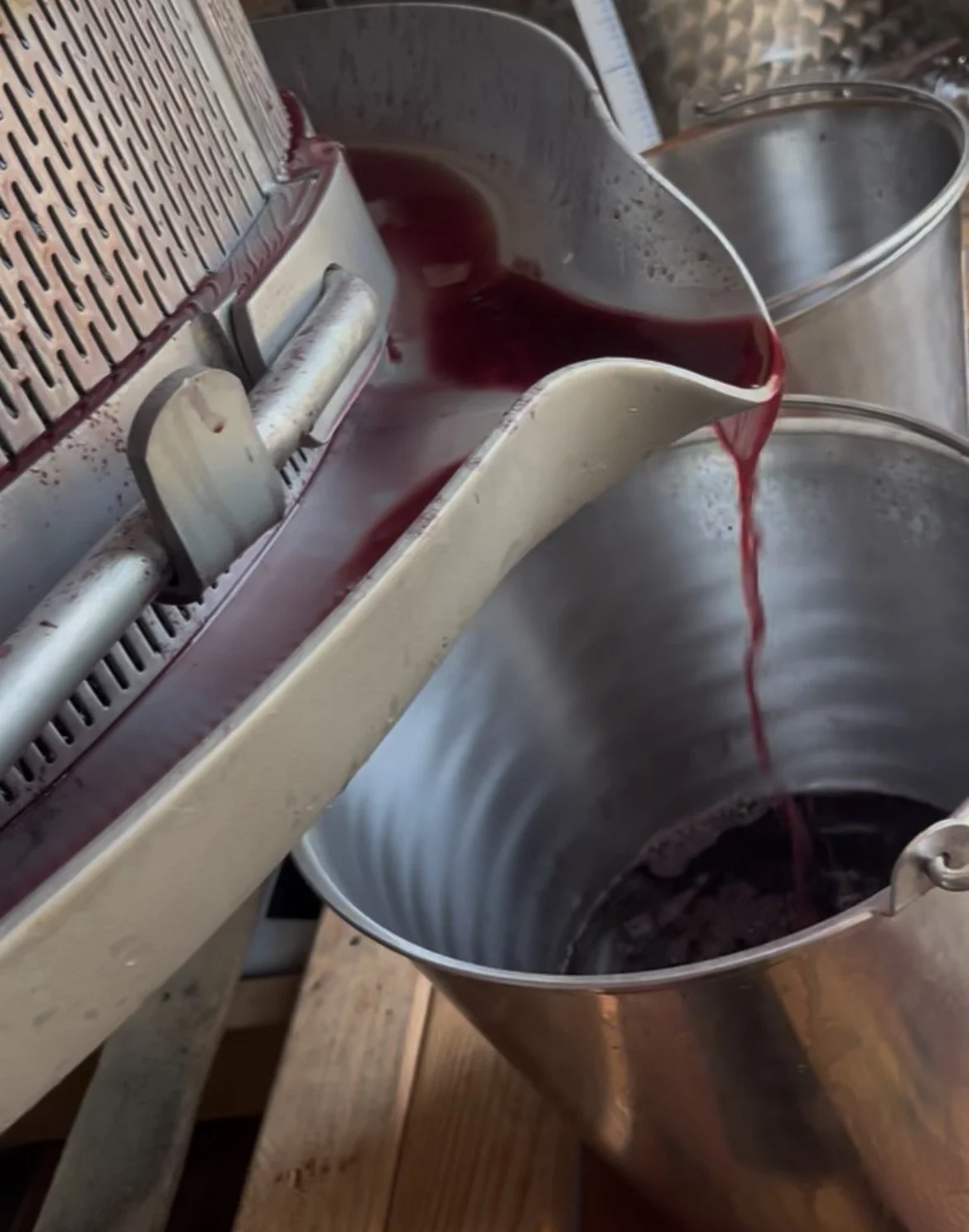
What do I do when my love is away?
Whether we were replacing lost grapes, lost vines, or lost time, we got by with a little help from our friends in 2026.
Working With Great Farmers
We had less fruit on Mount Alto this year, losing roughly 85% of our potential harvest was lost when the frost poured down the mountain in late April. In the abstract, we know that this is the path of the farmer, but there is still a price to be paid economically, practically and emotionally. Economically, the sting is mitigated somewhat by the fact that since 2024 we’ve worked with the growers at Mount Juliet Farm (aka Grace Estate Winery), and some of our cabernet losses could be offset by Mount Juliet merlot. Wine-grower Noe Garcia and his crew are highly-skilled farmers who (like ourselves) focus on regenerative farming practices, using neither herbicide nor tillage for weed control (better environmentally and also=better wine!!). They grow some of the best merlot we’ve ever tasted, they are a source of wine-growing knowledge and they had our back when we really needed them this year.
New Rootstocks
The frost losses we faced were mostly temporary, that is, most of the vines lived to bear fruit another vintage, but about 5% of our vines got killed, but those that perished spurred us on to look at our farming from a new angle. Turns out, the scientists at Virginia Tech has speculated that the frost damage was exacerbated by a brief January warm-spell which interupted dormancy, followed by a wicked cold front which weakened the vines. So we made friends with a new nursery grower who had some eye-opening ideas about how rootstocks can affect the vines resistance to adverse winter events. A test planting is scheduled for this spring and we're excited to peel one more tiny layer of skin off this onion.
Friends & Farm to Table
One of the more noticeable effects of frost in the vineyard was the seemingly random eruption of new shoots, and lateral shoots as the vines responded to the stresses of the frost damage. While normally shoot thinning and leaf removal takes place over a couple weeks in late May to early June, this year saw us repeating these tasks weekly through the beginning of August, lending a “Groundhog Day” type of feeling to the vintage. Fortunately, this repetitive work was counter-balanced by a bi-weekly visit to Mama Bird Farm (just over the mountain) for a rotating menu of farm to table Korean dishes with some of our fellow wine-growers. We’d leave our toils on Saturday afternoon to sit down with fellow farmers, commiserate about the season, and share fantastic food and bottles from fair-weathered vintages. The food was fantastic, and the company was even more restorative. We’re very grateful for these relationships, and our friends and neighbors in Esmont.
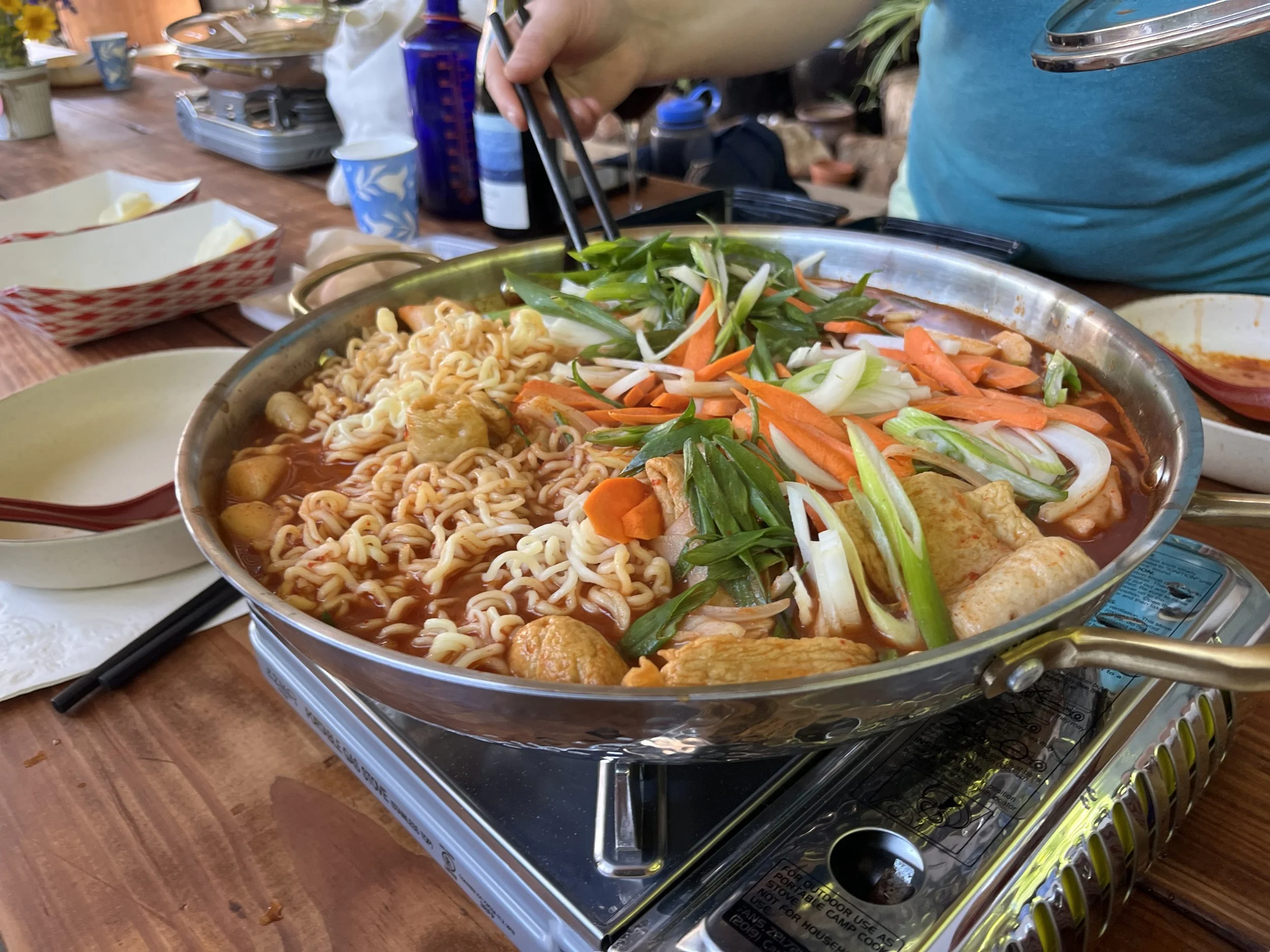
Lunch with friends, featuring a communal hot-pot at Mama Bird Farm.